THE HISTORY OF TWIN LAKES
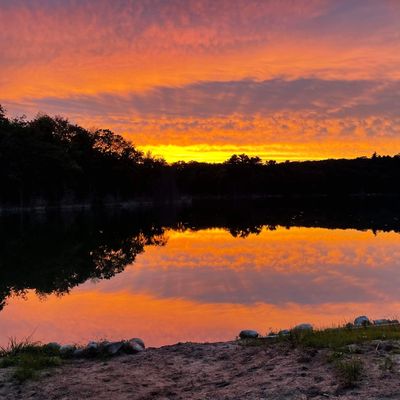
Twin Lakes is more than a beautiful place to live or visit, it is a landscape layered with stories. Beneath the quiet water, wooded shores, and winding roads lies a history shaped by Native American presence, early settlers, hardworking families, summer camps, and generations of change.
BEFORE THE NAME "TWIN LAKES"
Long before the lakes had a name, they were known and used by Native Americans who lived in and traveled through this region. Archaeological evidence suggests human presence here dating back thousands of years. The lakes themselves were formed by glacial activity. Retreating ice left behind depressions that filled with water, creating the natural beauty we see today.
Stone formations and artifacts found near the lakes, some arranged in patterns or resembling animals suggest ceremonial or cultural significance. These may have served as storytelling markers, seasonal guides, or spiritual symbols. Trails once crossed the land, connecting the lakes to broader networks used for hunting, gathering, and travel.
THE ARRIVAL OF SETTLERS
By the mid-1800s, immigrants, primarily from England, Scotland, and Germany, began settling in the area. These early homesteaders faced a rugged environment. Land was cleared by hand, homes built from logs, and supplies hauled long distances over primitive roads.
Life required resilience. Winters were harsh, medical care was scarce, and families relied heavily on one another. Yet, over time, a small but determined community took shape. Farms emerged, roads improved, and the rhythms of rural life became established.
One-room schools, like the Twin Lakes School, became central to community life. Children of all ages learned together, often walking long distances to attend. Teachers were young, resourceful and responsible not only for lessons but also for maintaining the school itself.
A COMMUNITY TAKES SHAPE
In the ealry 1900s, the area began to grow beyond subsistence farming. Small businesses appeared: a general store, blacksmith shop, and even a creamery. Lawrence, a nearby hub, became an important center for trade and social life.
The lakes themselves were central to daily living. Ice was harvested in winter and stored for use through the summer. Fishing was abundant, and the surrounding forests provided timber and fuel. Families gathered for shared work and recreation, building a strong sense of community.
INDUSTRY AND CHANGE
The natural resources of Twin Lankes also drew an interesting industry: marl mining. Marl was mined from West Twin Lakes and used by local farmers for fertilizer and soil amendment for the local sandy soil. Marl mining increased the depth of West Twin.
After the seven year drought of the Great Depression, the land surrounding Twin Lakes was not as we see it today. It was not covered with the tall, majestic "whispering pines" that currently grace the land. Thousands of trees were planted around the lakes during this time.
Fishing remained a defining feature, though not without intervention. By the mid-20th century, efforts were made to manage fish populations, including large-scale carp removal projects. These efforts reflected a growing awareness of environmental balance and stewardship.
FROM CAMP TO COMMUNITY
In the late 1940's, 200 acres of land was purchased around Twin Lakes for a Campfire Girl's summer camp. The camp, named Camp Tiyalaka, brought people from outside the region to experience the lakes' natural beauty. The camp operated for 37 years, during which time precious memories were made by thousands of young girls and eventually boys. After the Camp Fire organization sold their holdings, cabins and homes replaced the camp, and a new kind of community emerged, one that blended year-round residents with summer families. This shift marked the "end of an era" in some ways, but also the beginning of another. The lakes became a place not just of work, but of leisure, memory and connection.
TWIN LAKES CONSERVANCY IS BORN
In 2001, the Twin Lakes Conservancy was formed with the mission to preserve and improve the health and resilience of the lakes through monitoring, management, restoration, and stewardship of the waters, their shores and watersheds. For 25 years the conservancy has honored the rich history of our lakes while protecting the lakes for future generations. Twin Lakes Conservancy is a 501 (c)(3) nonprofit organization.
TWIN LAKES TODAY
Today, Twin Lakes is defined by both its natural beauty and its shared history. The forests have matured, the waters continues to draw fishermen and boaters, and the community remains closely tied to the land.
What makes Twin Lakes special is not just its scenery, but the continuity of care, from Native Americans who first understood its rhythms, to settlers who built lives here, to the young campers who learned to swim in the lakes' waters, to today's residents who value its preservation as its history continues to be made.